Space Force tasks a dozen companies for Golden Dome space-based interceptors
The service pledged it would demonstrate an “initial capability” for the orbital missile killers by 2028.
When asked if the American public has bought into the program, Guetlein said, “No.”
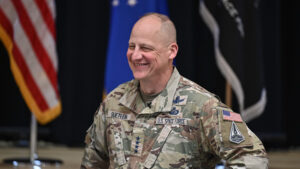
"If boost-phase intercept from space is not affordable and scalable, we will not produce it, because we have other options to get after it," said Space Force Gen. Michael Guetlein.
By raising the cost estimate to $185 billion, Gen. Michael Guetlein said it would accelerate development of the Airborne Moving Target Indication, space data network and the Hypersonic Ballistic Tracking Space Sensor.
Undersecretary of Defense for Acquisition and Sustainment Michael Duffey outlined key steps taken since an early November mandate to move out on acquisition reform.
In total, the agency is providing awards to 1,014 "qualifying offerors" for the Scalable Homeland Innovative Enterprise Layered Defense (SHIELD) program, under deals that could eventually total $151 billion over 10 years.
From emerging data networks to missile tracking and cyber resilience, Breaking Defense’s latest eBook brings together essential reporting on the evolving role of satellites in national security.
If the Pentagon does not start explaining Golden Dome, it will never be built, says Tom Karako of CSIS.
“We need a lot more information before we make decisions to spend hundreds and hundreds of billions of dollars," said Sen. Mark Kelly, D-Ariz.
Gen. Michael Guetlein, the Pentagon Golden Dome czar, said on Tuesday that the "real technical challenge" for the effort will be building space-based interceptors to knock down enemy missiles in their boost phase.
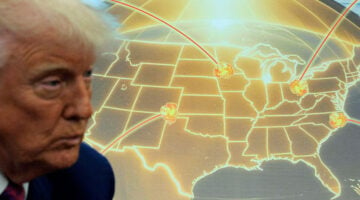
President Donald Trump said the project to develop a missile defense shield should be "fully operational" before the end of his term, and claimed Canada has asked to join the project.
Space Force leaders are sharpening their rhetorical swords regarding the service's need to build space warfighting chops.
Derek Tournear said he's concerned about cybersecurity and supply chain, and especially where they overlap: foreign-written software.
One of the key challenges for tracking enemy aircraft from space is that airplanes and drones move much faster than tanks, trucks and ships; confounded by the fact that satellites themselves also move around the Earth extremely fast.
"I would imagine that as Department of Commerce continues to mature this concept, we will definitely want to take advantage of what they're doing," said Vice Chief of Space Operations Gen. Michael Guetlein.